School Trays: Types, Sizing and What Actually Holds Up
Picking the right school desk is a key choice for a school when setting up or changing a learning space. Desks affect how students work. They help organise the classroom, support good behaviour, and help with focus. They are also important for comfort during the school day.
A well-chosen desk can help create a classroom that feels calm, purposeful and practical, while the wrong choice can make a space harder to manage, less flexible and less comfortable for both pupils and staff.
For UK schools, the decision is rarely as simple as picking a desk that looks right. Different age groups require different heights. Different subjects require different materials and layouts. Some classrooms need furniture that can be moved quickly to suit changing lesson formats, while others benefit from more fixed arrangements. Budget, durability, maintenance, storage and aesthetics all have to be considered alongside the day-to-day realities of school life.
This guide is designed to help schools make confident, informed choices. It explains the basics of what makes a good classroom desk, looks at the differences between desks and tables, explores the most common types of school desks used across UK education, and highlights the practical features that matter most when investing in new furniture. Whether you are furnishing a primary classroom, a secondary department, an ICT suite, an art room or an exam hall, the aim is the same: to help you choose a school desk solution that supports teaching, learning and long-term value.
At its simplest, a school desk is a workspace designed to support learning. In practice, though, school desks do much more than provide a surface for writing. They contribute to posture, focus, organisation and classroom flow. They determine how easily teachers can move around the room, how well pupils can access their resources, and how effectively a space can adapt to different styles of teaching.
The right desk can help pupils feel settled and supported. It can give them enough space to work without distraction, while also fitting the classroom in a way that allows smooth transitions, good sightlines and safe movement. For teachers and school leaders, selecting the right desks also has operational implications. Furniture affects cleaning, storage, maintenance, replacement cycles and the overall feel of the learning environment.
That is why choosing desks should never be treated as a purely decorative or last-minute purchasing decision. It is a practical investment in how a classroom functions every day.
Schools ask a great deal of their furniture. Desks need to withstand constant daily use, support pupils of different ages and sizes, and continue performing well over many years. A poor choice can lead to discomfort, wasted space, difficult layouts, and more frequent replacement costs. A good choice supports learning and proves its worth over time.
The importance of selecting the right school desk becomes even clearer when you think about the variety of settings within a school. A Year 1 classroom has very different needs from a Year 11 exam hall. An ICT room needs cable management and space for screens, while an art room needs surfaces that are hard-wearing and easy to clean. A design and technology environment may require heavy-duty workbenches rather than conventional desks. This is why schools benefit from approaching furniture selection strategically, rather than trying to find a one-size-fits-all solution.
There is no single desk that works for every room or every pupil. Some classrooms rely on individual desks arranged in rows or pairs. Others work better with larger classroom tables that encourage collaboration. Specialist rooms often call for more tailored solutions, such as ICT desks, exam desks or D&T workbenches.
The most common categories include individual classroom desks, classroom tables, teacher desks, ICT and computer desks, activity and art desks, exam desks, group desks and specialist workbenches. Each of these serves a different purpose and should be judged against the needs of the pupils, the subject being taught and the physical layout of the room.
This guide walks through the key desk types used in UK schools and explains how to compare them. It starts with one of the most common questions schools face: whether a classroom needs desks or tables. From there, it looks at dimensions and ergonomics, then explores desk options by age group and by function. Finally, it covers the features to look for, budgeting considerations and the long-term value of making the right choice.
One of the first decisions schools often face is whether to choose individual desks or classroom tables. Both have clear advantages, and the right option depends on how the space is used, the age of the pupils and the teaching style being supported.
Individual desks remain a popular school desk choice in many classrooms, particularly where independent work, written tasks and formal classroom structure are priorities. They give each pupil a defined personal workspace, which can help reduce distractions and support concentration. In classrooms where routine and order are especially important, individual desks can make behaviour management and seating plans easier to maintain.
They are often best suited to settings where pupils complete a high volume of written work, where exam-style conditions are common, or where the school wants to create clear boundaries between workspaces. They also allow teachers to rearrange layouts in rows, pairs or small clusters, depending on need.
The main strength of individual desks is the sense of structure they create. Pupils know where their materials belong, teachers can manage spacing more easily, and classrooms can feel organised and purposeful. However, individual desks can also take up more floor space than some table arrangements, particularly if the room needs generous walkways. They may also be less effective in classrooms where collaboration and group-based learning happen frequently throughout the day.
Classroom tables offer a different type of learning environment. Rather than separating pupils into individual stations, they create shared work areas that support discussion, paired tasks and collaborative activity. In many primary settings, and in some flexible secondary classrooms, tables are preferred because they help teachers move easily between independent and group work.
Tables are often best for collaborative classrooms, creative lessons, project-based learning and younger age groups who benefit from a more social and interactive layout. They can make efficient use of space and often suit multi-purpose rooms where the furniture needs to support a range of activities across the day.
Their main advantage lies in flexibility and social learning. Pupils can work together more naturally, resources can be shared more easily, and the room often feels more open. On the other hand, tables can blur personal boundaries between workspaces, and in some classrooms this may increase low-level distraction. For formal written tasks or testing, tables may also be less ideal than individual desks.
In practice, many schools use a mixture of both. The best decision depends on whether the room is designed mainly for independent focus, collaborative work, or a balance of the two.
Desk dimensions matter far more than many people first realise. A desk that is too high or too low can make it harder for pupils to sit comfortably, maintain good posture or work efficiently. Over time, poor sizing can contribute to discomfort, fatigue and reduced attention.
In UK schools, desk sizing is generally considered in relation to pupil age, height and the recognised BS EN 1729 Sizemark standard. This standard links chair seat height and table height to pupil stature, helping schools choose furniture that supports good posture and effective working. Common classroom sizes include Size Mark 2 with a 310mm seat height and 530mm desk height, Size Mark 3 with a 350mm seat height and 590mm desk height, Size Mark 4 with a 380mm seat height and 640mm desk height, Size Mark 5 with a 430mm seat height and 710mm desk height, and Size Mark 6 with a 460mm seat height and 760mm desk height. These are the sizes most often relevant in mainstream primary and secondary schools.
Standard size guidance helps schools choose desks that match their age group, but the practical reality is that there is always some variation within a class. That is why a thoughtful approach to sizing is important, especially in mixed-age settings or schools with pupils whose height range varies significantly. The Sizemark system is most useful when schools treat it as a guide to pupil fit, rather than relying on year group alone.
Ergonomics in school furniture is about more than comfort. It is about helping pupils work well. A correctly proportioned school desk supports posture, allows comfortable arm positioning, and reduces physical strain during long periods of sitting. This matters particularly in classrooms where pupils spend a large part of the day reading, writing or using screens.
Good ergonomics also help teachers. When pupils are sitting comfortably, they are often better able to concentrate and less likely to fidget because of discomfort. Desks should provide enough legroom, enough working area for books and equipment, and an appropriate relationship between the seat height and desk height. Under BS EN 1729, that relationship is built into the Sizemark system, which is why matching the desk to the correct chair height is just as important as choosing the right desk on its own.
Primary school desks need to support a wide variety of activity across the school day. Younger pupils move regularly between writing, drawing, practical tasks, paired work and carpet-based teaching. Furniture therefore needs to be hard-wearing, easy to maintain and appropriately sized for developing bodies.
In primary settings, desk height should match the size of the children using it. Under the BS EN 1729 Sizemark standard, the most common primary school sizes are Size Mark 1, with a 260mm seat height and 460mm desk height; Size Mark 2, with a 310mm seat height and 530mm desk height; Size Mark 3, with a 350mm seat height and 590mm desk height; and Size Mark 4, with a 380mm seat height and 640mm desk height. In practical terms, this means younger pupils in Nursery and Reception are more likely to need the lower Sizemarks, while older Key Stage 2 pupils often move into Size Marks 3 or 4, depending on their stature.
Schools should avoid choosing furniture purely by year group without considering the actual age and size range of the children. Proper height selection supports comfort, posture and confidence, especially for younger pupils who are still developing fine motor control and classroom independence. Where there is uncertainty, measuring pupil stature or checking existing chair heights against the Sizemark guide can make the choice much clearer.
Secondary classrooms often place greater emphasis on subject-specific learning, independent work and longer periods of seated concentration. As a result, the demands placed on a school desk in secondary education can be different from those in primary.
Secondary pupils need taller desks to match their increased height and reach. Within the BS EN 1729 Sizemark system, the most common secondary sizes are Size Mark 5, with a 430mm seat height and 710mm desk height, and Size Mark 6, with a 460mm seat height and 760mm desk height.
In some sixth form or adult-learning environments, schools may also use Size Mark 7, which is generally associated with a 510mm seat height and 820mm desk height or above.
Choosing desks that are too small for older pupils can lead to poor posture and discomfort, especially during lessons that involve extended writing or computer use.
Desk sizing should also be considered alongside chair height so that the working position feels natural and supportive. This is particularly important in secondary schools, where pupils can vary significantly in height within the same year group.
A school desk in a primary classroom has to be versatile. It may be used for handwriting practice, maths work, reading tasks, art activities and topic-based learning, all within the same day. In some schools, desks also need to support shared use of tablets or laptops, or be easy to move for different classroom layouts.
This is why many primary schools favour flexible desks or tables that can support both individual and group activities. Surfaces need to be robust enough for daily classroom life and simple to wipe clean after messy tasks.
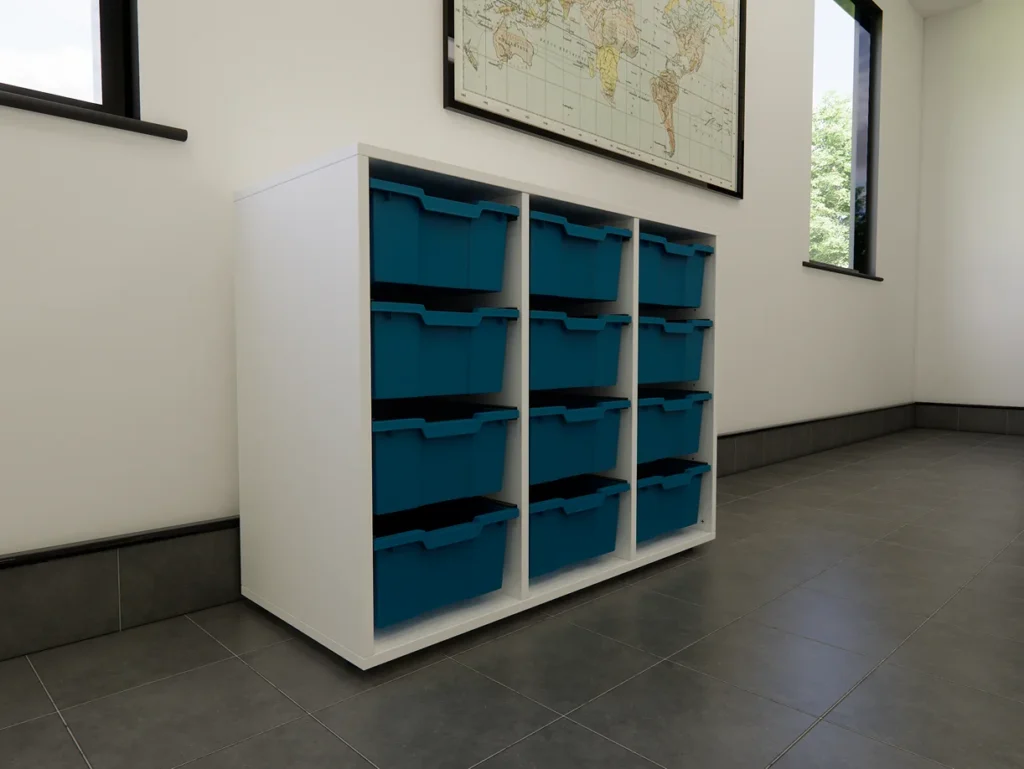
When choosing primary school desks, schools should think carefully about classroom size, how often layouts change, and whether pupils need integrated storage or open access to trays and resources. The visual look of the desks also matters in younger settings, where colour and shape can influence the feel of the room. Furniture should be practical, but it should also contribute to a welcoming and age-appropriate learning space.
The term school desk covers a wide range of furniture types, each with a different role in the school environment. Understanding these categories helps schools choose more accurately for each room and use.
Classroom desks are the standard desks used by pupils in general teaching spaces. They may be individual desks, rectangular desks for paired use, or compact formats designed to maximise space. Typical features include durable tops, stable frames, modesty panels in some designs, and finishes selected for easy cleaning and long-term wear.
These desks are often the backbone of the school furniture estate, so they need to balance comfort, durability and value. A well-chosen classroom desk should feel dependable, fit the room neatly and support everyday teaching without drawing attention to itself.
Teacher desks have a different function. They need to support planning, administration, storage and classroom management. A teacher’s desk should offer enough surface area for paperwork, marking and digital devices, while still fitting well within the classroom. Storage is often more important here than with pupil desks, especially where teachers need drawers, secure compartments or space for teaching resources.
The best teacher desks feel practical rather than bulky. They should support the teacher’s working day without dominating the classroom or making movement more difficult.
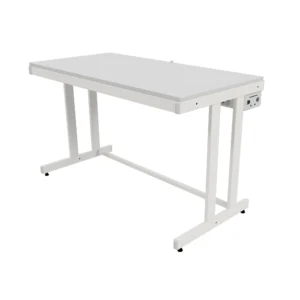
ICT and computer desks must support technology use in a way that feels organised and safe. Cable management is particularly important, as loose wires can quickly make a room feel untidy and create hazards. Desks should provide enough depth for monitors or laptops, room for keyboards and peripherals where needed, and a layout that allows pupils to work comfortably without crowding equipment.
In some ICT environments, desks may include cable ports, under-desk management features or tray options. The goal is to make digital learning straightforward while keeping the room visually clean and easy to maintain.
Activity and art desks need to cope with more demanding materials and messier processes than a standard classroom desk. Surfaces should be durable, easy to wipe down and resistant to the marks and spills that come with paints, glue, clay and practical tasks. In many schools, these desks also need to support movement around the room and allow resources to be shared easily.
Because art and activity spaces often host a wide range of work, the best desks in these settings are those that feel robust, forgiving and easy to maintain over time.
Exam desks have a very specific purpose. They are designed to provide each pupil with a distraction-free, individual workspace. They are usually simple in design, stable and easy to arrange in rows with consistent spacing. The emphasis is on fairness, clarity and function rather than collaboration or storage.
Schools often value exam desks that are easy to stack, store or deploy quickly when larger spaces need to be converted for formal assessments.
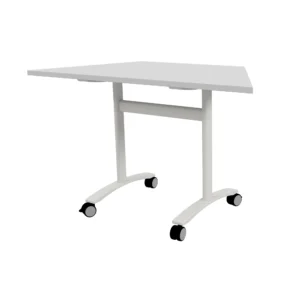
Group desks are designed for shared work and collaborative learning. They may come in shapes such as trapezoids, hexagons or other modular forms that allow multiple desks to be grouped together neatly. These desks work particularly well in classrooms where discussion, teamwork and active learning are central to the teaching approach.
The shape of the desk can influence classroom dynamics. Group desks help create a sense of shared responsibility and can make lessons feel more interactive, though schools also need to think about how these layouts affect focus during quieter tasks.
D&T classroom workbenches sit at the more specialist end of the school desk spectrum. These are not standard desks but heavy-duty working surfaces designed for practical making and construction tasks. They need strong frames, hard-wearing tops and the ability to cope with more physical classroom activity. In some settings, they also include storage for tools and materials, different top options for specific activities, and even vice integration where appropriate.
Height is a particularly important factor in D&T spaces, especially if pupils are expected to work standing for some tasks. A good workbench should feel secure, durable and well suited to the specific practical activities taking place in the room.
When comparing desk options, it helps to focus on the features that affect long-term performance in real classrooms.
Some schools need desks that remain in place, while others benefit from furniture that can be moved quickly. Mobile desks or lightweight configurations can be particularly useful in spaces that host different activities throughout the day. Flexibility is valuable where teachers regularly switch between whole-class teaching, paired work and group tasks.
Durability is one of the most important features in any school desk. School furniture takes daily wear from books, bags, movement, spills and repeated cleaning. Materials should therefore be chosen with long-term use in mind. Strong frames, resilient surfaces and good-quality edging all make a significant difference to lifespan and appearance over time.
Height-adjustable desks can be useful where schools want greater flexibility or where rooms are used by different age groups. They can also help in specialist settings where posture and ergonomic fit are especially important. While they may involve a higher initial cost, they can offer added versatility in the right context.
Standing desks are becoming more common in some learning environments, particularly where schools want to introduce more movement into the day. They are not a complete replacement for traditional seating-based desks, but they can be a useful addition in certain spaces, especially for short-task work, flexible learning zones or older pupils.
The right choice depends on how the desk will be used, who will use it and where it will be placed. Schools should think carefully about the balance between function, layout, age group and long-term value.
Space is always a practical constraint. Even the best desk can become the wrong choice if it makes the classroom feel cramped or difficult to navigate. Schools should measure carefully, think about walkways, storage access and visibility, and consider how furniture will affect the overall flow of the room.
A school desk for a reception child and a school desk for a sixth form student should not be treated as interchangeable. Age, size and activity all matter. Younger pupils often need more flexible layouts and furniture suited to creative, multi-purpose use, while older pupils may need desks that support long periods of independent work.
Furniture affects the atmosphere of a classroom as much as the practical layout. Colour, finish and shape all contribute to how the space feels. Some schools prefer calm, neutral tones that support focus and reduce visual noise. Others use colour more actively, particularly in primary classrooms, to create energy and character. The right choice depends on the wider environment and the effect the school wants to create.
Cost matters, but the cheapest option is not always the best value. A desk that needs replacing sooner, is harder to maintain or does not suit the classroom properly can end up costing more over time.
The cost of a school desk varies depending on its size, material, design and intended use. Standard classroom desks are generally more affordable than specialist ICT desks, art desks or D&T workbenches, but schools should always compare like with like. Storage, adjustability, mobility and specialist features will affect the price.
Budgeting well means looking beyond the headline unit cost. Schools should consider delivery, assembly, expected lifespan, maintenance requirements and the practical value of the desk in use. It is also worth thinking about phased purchasing. In some cases, replacing the most urgent areas first and planning future upgrades can be more manageable than trying to refurnish an entire site at once.
A sensible budgeting approach usually focuses on three things:
This kind of thinking often leads to better purchasing decisions than cost alone.
Warranty matters because it reflects confidence in the product. A good warranty can offer reassurance about build quality and reduce risk when making a larger furniture investment. Schools should also check returns policies, replacement part availability and whether after-sales support is available if problems arise after installation. Thankfully, Nortek Group offer industry leading warranty and after-sales support – for more information simply email sales@nortekgroup.co.uk.
Selecting the right school desk is about far more than filling a classroom with furniture. It is about creating an environment that supports the way pupils learn, the way teachers teach and the way a school operates day after day. The best desk is one that fits its users, suits its subject, works within the available space and continues to perform well over time.
There is no universal answer that suits every school or every room. Some spaces benefit from individual desks that create structure and focus. Others work better with tables, group desks or specialist furniture. The key is to begin with the real needs of the classroom rather than making assumptions based on appearance or habit.
A well-chosen school desk delivers long-term value through durability, usability and fit for purpose. It helps classrooms function better, supports comfort and concentration, and reduces the likelihood of costly replacements or layout problems later on. When schools take the time to choose carefully, they are not simply buying furniture. They are investing in better learning environments for years to come.