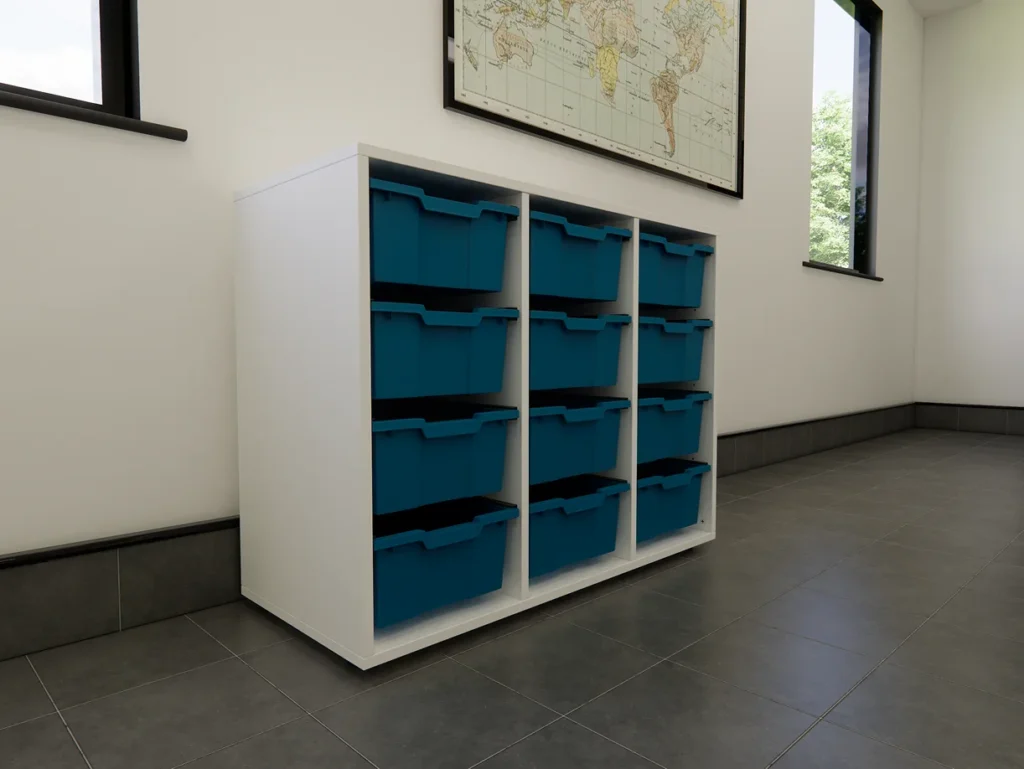
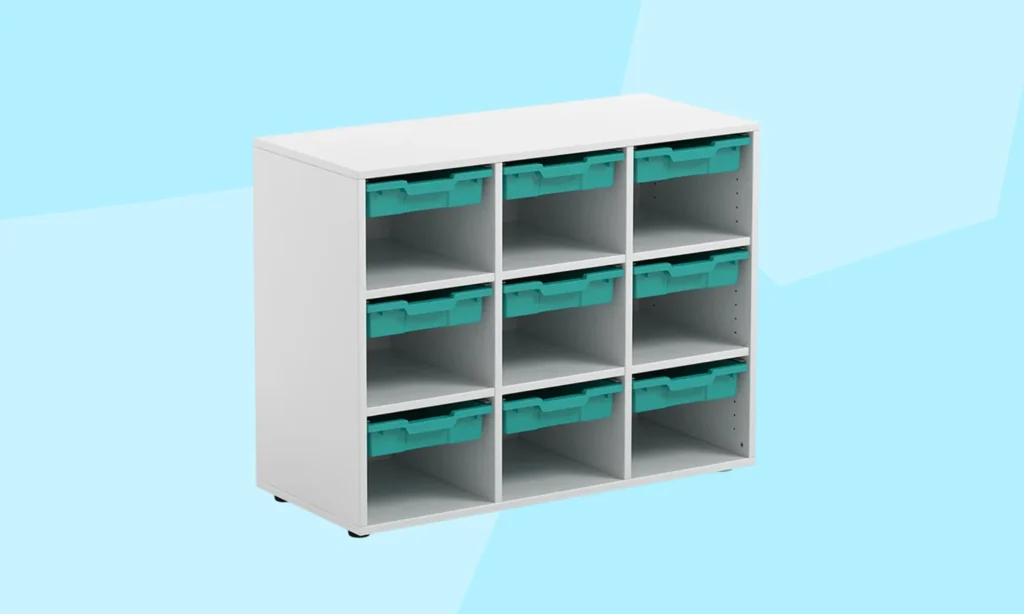
Whether you’re kitting out a reception classroom, a busy Year 4 room, or a secondary science lab, the tray system you choose affects how easily pupils find their own materials, how quickly a room tidies at the end of the day, and how well storage holds up under years of daily use. This guide walks through the main types of school trays, what to consider before you buy, and how tray storage fits into a wider classroom storage plan.
What are school trays used for?
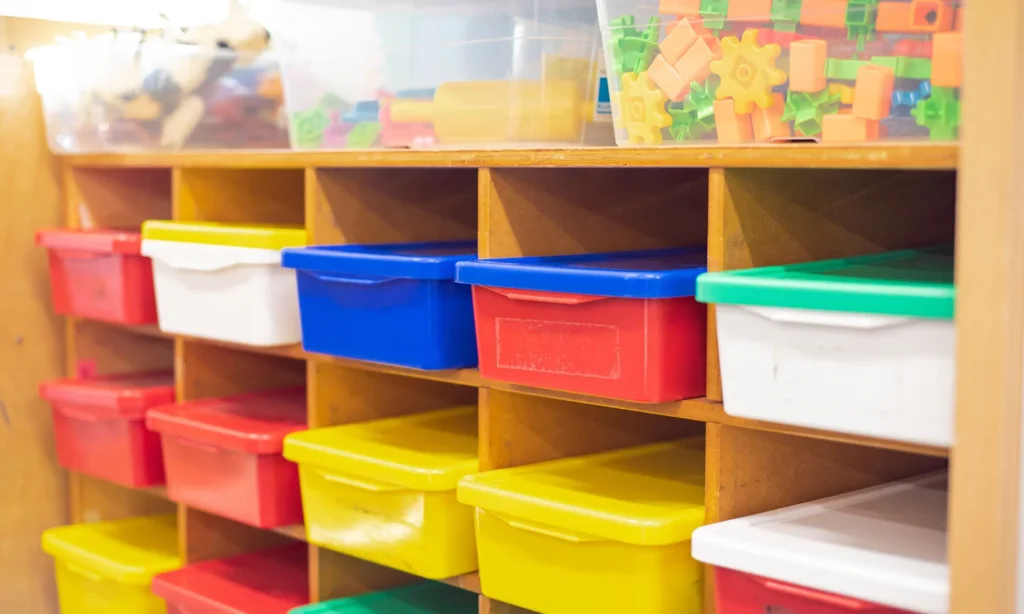
School trays give each pupil, group or subject area its own dedicated storage space within a larger unit. They’re used to store books, folders, stationery, art materials and equipment, and can be colour coded so pupils, teachers and support staff can find and return items quickly.
In primary classrooms, trays are often assigned to individual pupils and used to store reading books, workbooks and personal items, making it easy for children to manage their own belongings and build a bit of independence. In secondary schools and specialist departments, trays are just as useful for storing subject specific equipment, art materials, or DT and science resources at the point of use. Because tray units are open fronted, contents are visible at a glance, and each tray can be labelled to keep the system running smoothly even in a busy shared classroom.
Types of school trays
School tray storage generally falls into three broad categories: static units and cupboards, mobile trolleys, and specialist storage for art, DT or science materials. The right choice depends on how much you need to store, whether it needs to move around the school, and whether it needs to be secured.
Static tray units and cupboards
Static tray units sit in a fixed position in the classroom and are available as open units or fully enclosed cupboards with lockable doors. They range from compact units holding a handful of trays to larger banks that can store materials for a whole class.
Nortek’s tray storage units are available from compact six tray units up to larger thirty tray banks, so a classroom can be specified for its exact pupil numbers rather than settling for a fixed size that doesn’t quite fit. Enclosed cupboard versions add a lockable door, useful for confidential materials, staff resources or supplies that shouldn’t be freely accessible to pupils.
Mobile tray trolleys
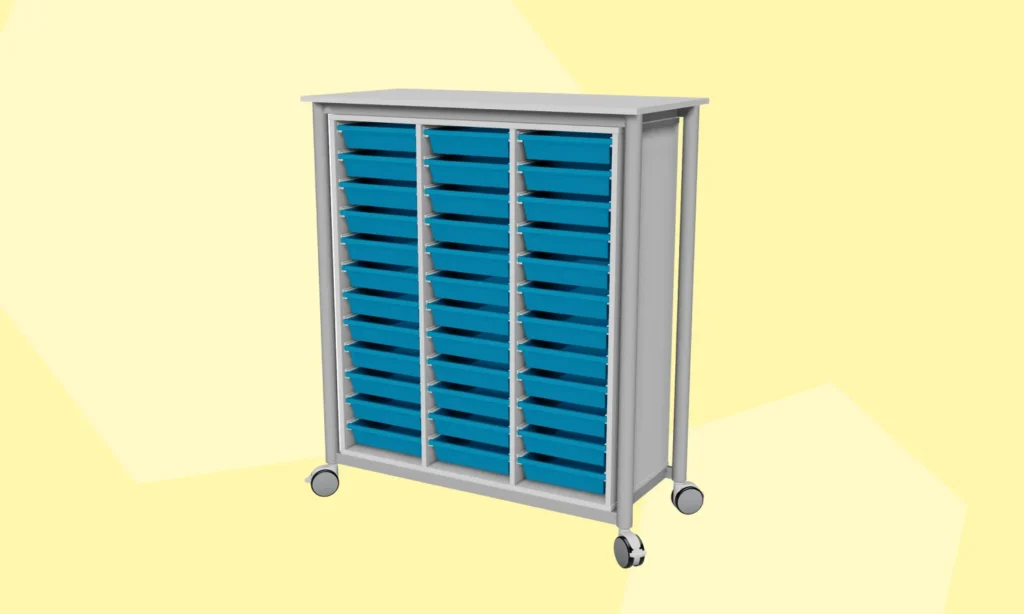
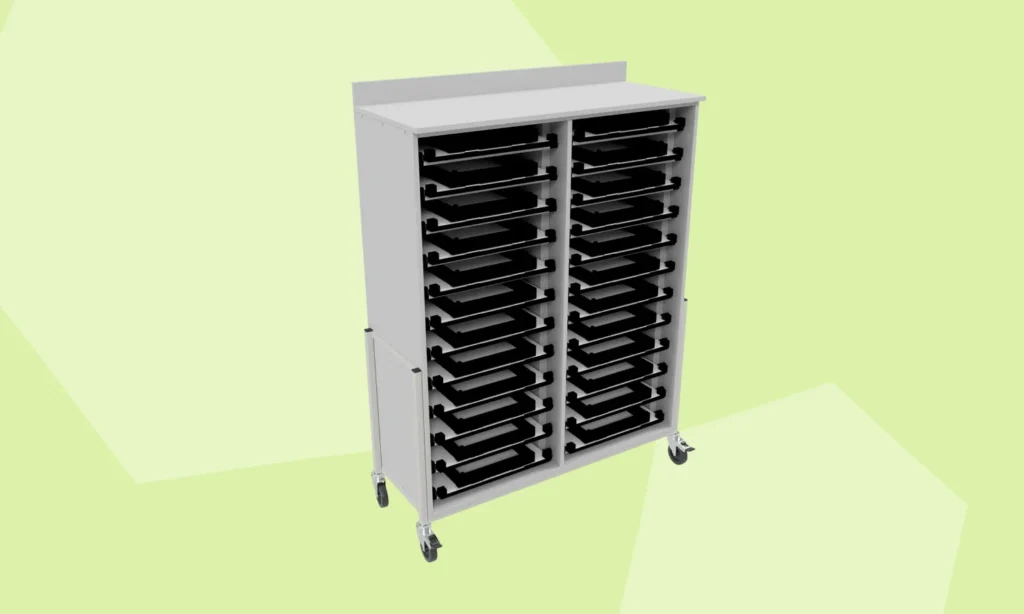
Mobile tray trolleys sit on castors so they can be wheeled between classrooms or repositioned during a lesson, which suits shared resource areas, primary schools moving materials between rooms, and DT departments.
Because they can be locked in place with castor brakes, mobile units offer the flexibility of movement without sacrificing stability once positioned. They’re a practical option for schools that share resources across several classrooms, or that need to reconfigure a room quickly between lessons. Take a look at our multi-purpose trolleys for mobile storage options that go beyond trays alone.
Specialist tray storage for art, DT and science
Some tray applications need more than a standard general-purpose unit. Art departments need wider, flatter trays for portfolio work and paper stock, while DT workshops and science labs need trays built into underbench storage at the point of use.
A general classroom tray unit isn’t always the right fit for A3 paper, wet art materials or lab equipment. Specialist tray configurations, whether that’s wider trays for art paper or underbench storage in a DT workshop, solve problems a standard tray bank can’t. If your school covers a mix of general classrooms and specialist rooms, it’s worth specifying tray storage room by room rather than applying one solution across the whole building.
How to choose the right tray storage for your classroom
The right tray storage depends on pupil numbers, the age group using the room, and whether the unit needs to be mobile or secured. A reception classroom, a Year 6 room and a secondary science lab all have different requirements, even though they might use the same basic tray system.
In primary settings, tray units are usually assigned per pupil, so classroom capacity should guide how many trays you specify, with a little extra allowance for group or shared resources. Younger year groups tend to need larger, more open trays that are easy for small hands to manage, while older primary pupils can typically use standard tray sizes. In secondary schools, tray storage is more likely to serve a specific subject or department rather than an individual pupil, so it’s worth thinking about what the tray needs to hold: exercise books and folders in a general classroom, or tools and components in a DT workshop.
The government’s own area guidance for mainstream schools includes a dedicated section on storage space when planning classroom layouts, which is a useful starting point if you’re specifying a new build or refurbishment rather than replacing existing units.
If several classrooms or year groups are involved, our team can help plan tray numbers and configurations against your actual pupil numbers rather than working from a generic size, particularly useful when specifying storage across primary or secondary settings, or for early years classrooms where safety and accessibility matter most.

What to look for when buying school trays
Not all tray storage is built to the same standard. Frame construction, tray material, and whether the supplier manufactures in-house or resells third-party trays all affect how long a unit lasts and how well it’s supported if something goes wrong.
Frame construction and durability
The frame is what determines how long a tray unit lasts under daily classroom use. Look for fully welded steel or solid MFC (melamine-faced chipboard) frames rather than knock-down fixings or plastic corner joints, which loosen with repeated use over time.
A tray unit gets opened, closed, loaded and unloaded constantly throughout the school day. Cheaper knock-down construction might look identical to a fully welded frame in a catalogue photo, but the difference becomes obvious within the first year or two of use, particularly in primary classrooms where units see the heaviest daily wear.
Who actually manufactures it
Most school tray storage on the market is resold from third-party manufacturers rather than built by the supplier itself. That’s worth knowing, because it affects how far a supplier can go on bespoke sizing, non-standard configurations, or resolving a problem quickly if a part fails.
Nortek manufactures tray storage units in-house at our factory in Congleton, Cheshire, where we’ve built school furniture since 1976. Every unit is backed by our warranty, and because we design and build the products ourselves, we can produce non-standard sizes or specific configurations that catalogue suppliers reselling third-party stock simply can’t match.
Security where it’s needed
Any storage holding confidential pupil records, staff belongings or materials that shouldn’t be freely accessible needs a lockable option. This applies to some tray cupboards as much as it does to general classroom storage.
Science labs, DT workshops and staff work areas are the settings where lockable tray storage tends to matter most, though it’s worth checking your specific requirements against general classroom safety practice.
Ordering, delivery and installation
Most standard tray storage orders are completed within four to six weeks from confirmed specification, with delivery and installation handled by the same team throughout.
Nortek manages the process from enquiry to installation, agreeing a lead time once your specification is confirmed and arranging delivery and assembly with our own experienced installation team. Purchase orders are welcome and flexible payment options are available. For a broader look at planning classroom storage beyond trays alone, our classroom storage buying guide covers cupboards, mobile trolleys and workshop storage too.
Frequently asked questions
What is tray storage used for in a classroom?
Tray storage gives each pupil, group or subject its own dedicated space for books, folders, stationery or equipment. It’s most widely used in primary classrooms, where individual pupil trays support tidiness and independent access, but it’s just as useful in secondary departments and specialist rooms like art and DT.
What sizes do school trays come in?
Tray sizes generally range from shallow trays, suited to paper and slim books, through to deep and jumbo trays for bulkier items like folders and equipment. Units can be specified with a single tray size throughout, or a mix, depending on what the classroom needs to store.
What’s the difference between mobile and static tray storage?
Static units sit in a fixed position and suit classrooms that don’t need to reconfigure often. Mobile trolleys sit on lockable castors, so they can be moved between rooms or repositioned during a lesson, which suits shared resources and departments like DT that move equipment around regularly.
Can tray storage be customised for our school?
Yes, at least with a manufacturer that builds in-house. Because Nortek designs and builds tray storage at our own factory, we can produce units to non-standard dimensions, specific tray configurations, or finishes matched to your existing classroom scheme.
Whether you need trays for a single classroom or a full-school refurbishment, getting the configuration right from the start saves time and budget down the line. Contact our team for advice on the right tray storage for your school, or browse our full classroom storage range to see cupboards, trolleys and workshop storage alongside our tray units.
 Visit Nortek Industrial
 Visit Mirplay School